E-commerce Marketing in the UAE: A 2026 Growth Playbook
The UAE e-commerce market is worth $12.3 billion and growing at double-digit rates, but 58% of purchases already go to overseas vendors. Here's how UAE stores compete for the rest.
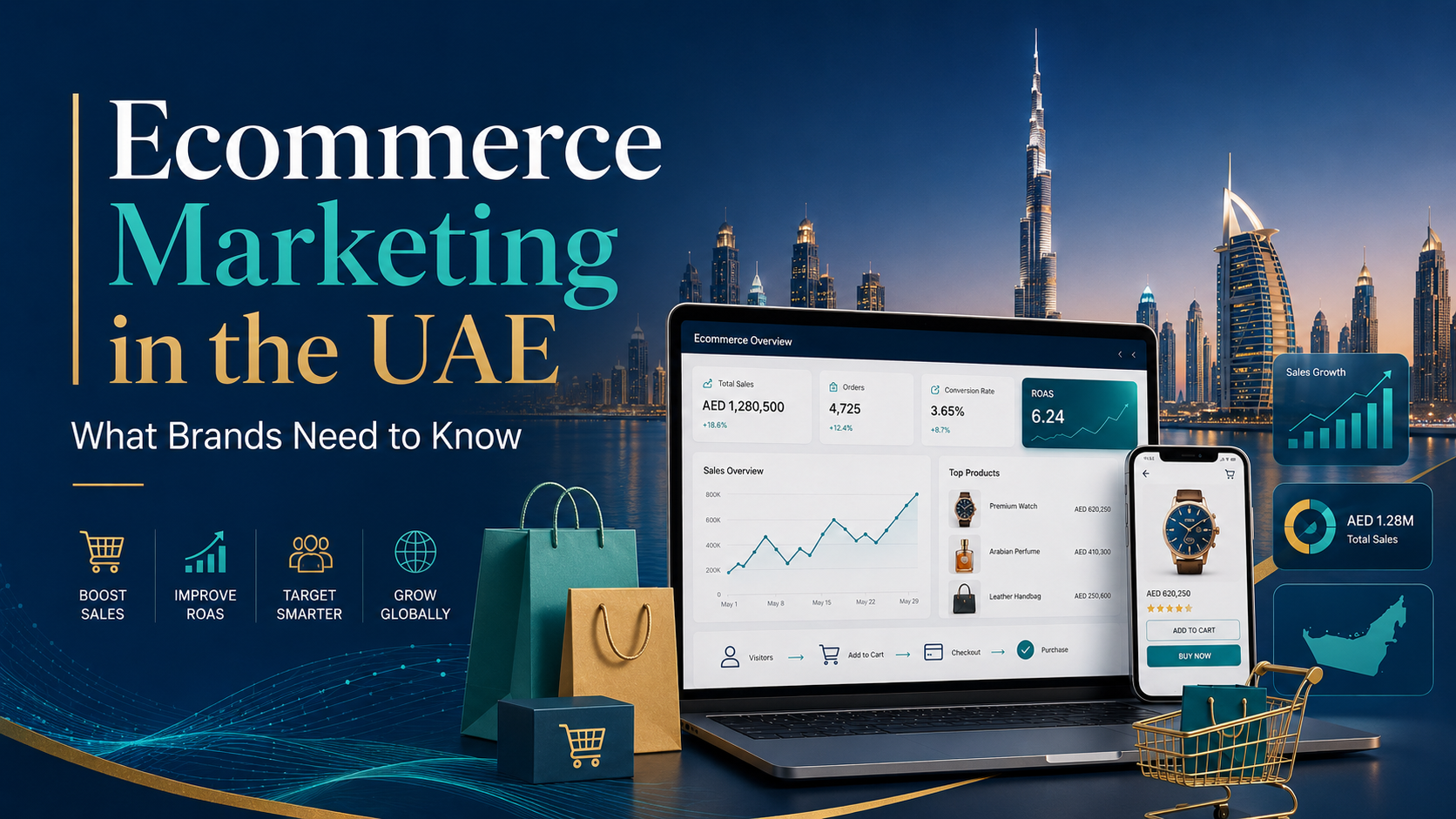
A market growing faster than most
2026 figures behind one of the region's most competitive e-commerce markets.
The UAE has one of the most digitally mature e-commerce markets in the region, and one of the most competitive. Roughly 11 million residents already shop online, spread across more than 45,000 active stores, and nearly half of total consumer spending in the country now happens online. Growth isn't the challenge here. Standing out is.
01The Size and Shape of the Market
The UAE e-commerce market is valued at approximately $12.3 billion in 2026, with forecasts placing it between $17 billion and $21 billion by 2031, a compound annual growth rate in the 11 to 12 percent range depending on the source. Dubai's wholesale and retail trade sector alone generated roughly AED 50.9 billion in Q1 2026, about 22% of the emirate's GDP.
Business-to-consumer sales account for roughly 68% of total online revenue, with business-to-business e-commerce growing even faster, projected at over 17% CAGR through 2031 as UAE companies digitise procurement and wholesale purchasing.
| Metric | 2026 figure |
|---|---|
| Market size | ~$12.3 billion, forecast ~$21B by 2031 |
| Online shoppers | 11.04 million |
| Active stores | 45,000+ |
| Mobile transaction share | 79% |
| Cross-border purchase share | 58% |
| Digital wallet usage | 53% |
02Mobile Isn't a Channel, It's the Default
79% of all e-commerce transactions in the UAE happen on a smartphone. That figure means mobile isn't a secondary experience to optimise after the desktop site is done, it's the primary experience the entire store should be designed around. Slow mobile load times, cramped checkout flows, or desktop-first product pages are directly costing UAE stores revenue, not just user experience points.
If a UAE store's checkout takes more than a few taps on mobile, it's losing customers to a competitor whose checkout takes fewer.
03Payment Behaviour: Cover Both Camps
UAE shoppers are split between two dominant payment preferences. Digital wallets reached 53% usage, driven by Apple Pay, Google Pay and regional options, while 67% of consumers still prefer credit or debit cards directly. The practical implication: stores that support both, plus cash on delivery where the category warrants it, remove friction for the widest possible share of buyers. Stores that force a single payment method are quietly filtering out customers before checkout even starts.
04The Cross-Border Threat
58% of online purchases in the UAE already go to overseas vendors. UAE consumers trust international platforms for secure payment gateways and reliable shipping, which means local stores are not just competing with each other, they're competing with Amazon, international fashion retailers, and global marketplaces by default.
This raises the bar for local stores on two fronts: trust signals need to be as strong as an international competitor's, secure checkout badges, clear return policies, visible customer reviews, and delivery speed needs to be a genuine differentiator, since "we're local" is not automatically a competitive advantage to a UAE shopper who already trusts overseas platforms.
05Where the Category Opportunity Is
Fashion and apparel dominates the UAE e-commerce landscape, with nearly 8,000 dedicated online stores, roughly 22% of total stores, and 38.7% of category revenue. Electronics, luxury goods and grocery delivery follow closely behind. High category density means differentiation matters more than category selection: a new fashion store isn't competing for a gap in the market, it's competing directly against thousands of existing players for the same mobile-first, price-comparing shopper.
06A Practical Marketing Framework
1. Treat SEO and paid search as complementary, not either/or
With over 45,000 stores competing nationally, organic visibility alone takes time to build. Paid search and shopping campaigns fill the gap while SEO compounds, particularly important for new stores entering saturated categories like fashion or electronics.
2. Build trust signals as deliberately as product pages
Reviews, secure checkout badges, clear delivery timelines and visible return policies aren't decoration, they're the difference between a UAE shopper choosing a local store over a familiar international one they already trust by default.
3. Optimise for the mobile checkout specifically
Given 79% of transactions happen on mobile, checkout flow, page speed and payment method availability on mobile should be tested and optimised independently from desktop, not assumed to inherit desktop performance.
4. Diversify payment options deliberately
Supporting both digital wallets and cards, rather than defaulting to whichever is easiest to integrate, directly expands the addressable share of the 53% wallet users and 67% card users, groups that meaningfully overlap but aren't identical.
5. Use social platforms as a discovery layer, not just an ad channel
With 68% of UAE Instagram users reporting a purchase after seeing a product on the platform, product discovery on social media is already converting. Shoppable posts, Reels demonstrations, and creator partnerships extend organic and paid reach into a channel UAE shoppers are already using to decide what to buy.
The stores winning in UAE e-commerce right now aren't necessarily the ones with the biggest ad budgets, they're the ones who removed the most friction between "saw the product" and "completed checkout."
07Customer Retention: The Underinvested Half of UAE E-commerce
Most UAE e-commerce marketing conversations focus almost entirely on acquisition, paid search, social ads, influencer partnerships, and comparatively little on what happens after the first purchase. Given how expensive acquisition already is in this market, that imbalance is costing stores real margin.
Email and WhatsApp remain underused retention channels
Despite the UAE's heavy social media usage, email marketing retains strong return on investment for e-commerce specifically, cart abandonment sequences, post-purchase follow-ups, and replenishment reminders for consumable categories all convert at a materially lower cost than paid acquisition. WhatsApp Business, given the platform's near-universal reach in the UAE, has become an increasingly effective channel for order updates, personalized recommendations, and direct customer service, often outperforming email open rates by a wide margin among UAE shoppers.
Loyalty programs need to reflect UAE shopping behaviour specifically
Generic points-based loyalty programs modeled on Western retail patterns often underperform in the UAE, where a large share of the population is transient or relocating within a few years. Programs built around immediate, tangible value, next-purchase discounts, free delivery thresholds, exclusive early access, tend to outperform long-horizon points accumulation for this demographic.
Repeat purchase rate is the metric most UAE stores don't track
Given how much of UAE e-commerce revenue depends on repeat behaviour in categories like fashion, beauty and grocery delivery, repeat purchase rate deserves the same attention as conversion rate and average order value. Stores that segment customers by first-purchase category and build targeted win-back campaigns for lapsed repeat categories consistently see stronger lifetime value than those relying purely on broad retargeting.
08Logistics and Delivery: A Marketing Problem, Not Just an Operations One
Delivery experience directly shapes purchase decisions and repeat behaviour in the UAE more than in many other markets, largely because same-day and next-day delivery expectations were set early by regional players and international marketplaces alike.
Delivery speed is now a marketing claim, not a backend detail
UAE shoppers comparing a local store against an international competitor increasingly weigh delivery speed as heavily as price. Stores that can offer same-day delivery within Dubai, Abu Dhabi or Sharjah have a genuine differentiator worth featuring prominently in product pages and ad copy, not burying in a shipping policy page few visitors read.
Delivery cost transparency reduces cart abandonment
Surprise shipping costs at checkout remain one of the most common causes of cart abandonment across UAE e-commerce. Displaying delivery cost, or a clear free-delivery threshold, earlier in the shopping journey rather than only at final checkout consistently improves completion rates.
Returns policy clarity matters more for cross-category stores
Given that 58% of UAE online purchases already go to overseas vendors whose return policies are often well understood by shoppers, local stores competing in categories like fashion, where sizing uncertainty drives return rates, need equally clear and equally generous return policies to compete credibly rather than losing the sale to hesitation at checkout.
09Marketplace Presence: Complement, Don't Replace, Your Own Store
Regional marketplaces, Amazon.ae, Noon and category-specific platforms, carry a significant share of UAE online shopping traffic, and many UAE brands treat marketplace presence and direct e-commerce as competing priorities rather than complementary ones.
Marketplace listings offer built-in trust and discovery, particularly valuable for new brands still building direct traffic, but typically come with materially higher take rates and far less customer data ownership than a brand's own store. The stronger long-term pattern for UAE e-commerce brands is using marketplaces for discovery and new customer acquisition, while investing owned-channel marketing, email, WhatsApp, retargeting, toward migrating repeat customers to the direct store, where margins are higher and the customer relationship is fully owned.
Brands that treat marketplace presence as the entire strategy typically plateau once marketplace algorithm changes or increased seller competition compress visibility, a risk that a parallel direct-store strategy meaningfully hedges against.
10A Launch and Growth Checklist
- Audit mobile checkout flow specifically, independent of desktop performance
- Offer both digital wallet and card payment options at minimum
- Build visible trust signals: reviews, secure checkout badges, clear delivery and return policy
- Run SEO and paid search in parallel rather than sequencing them
- Treat Instagram and TikTok as product discovery channels, not just brand awareness
- Benchmark delivery speed against major cross-border competitors, not just local ones
- Monitor category-level competition density before assuming a niche is under-served
11Frequently Asked Questions
How big is the UAE e-commerce market in 2026?
The UAE e-commerce market is estimated at approximately $12.3 billion in 2026, with forecasts placing it at around $21 billion by 2031, an annual growth rate of roughly 11 to 12 percent.
Is UAE e-commerce mostly mobile?
Yes. Smartphones drive approximately 79 percent of all e-commerce transactions in the UAE, making mobile-first design and checkout experience a baseline requirement rather than an optimisation.
What payment methods should UAE online stores prioritise?
Digital wallets reached 53 percent usage in the UAE, while 67 percent of consumers still prefer credit or debit cards for online payments. Offering both, alongside cash on delivery where relevant, covers the majority of buyer preference.
How much of UAE e-commerce comes from overseas sellers?
Roughly 58 percent of online purchases in the UAE come from overseas vendors, reflecting strong consumer trust in international platforms and highlighting the competitive pressure local UAE stores face from cross-border retailers.
Which product category performs best in UAE e-commerce?
Fashion and apparel leads the UAE e-commerce market with roughly a 22 percent share of stores and 38.7 percent of total category revenue, followed by electronics, luxury goods and grocery delivery.
12Seasonal Demand Planning for UAE E-commerce
UAE e-commerce demand is unusually seasonal compared to many markets, shaped by a calendar of religious, cultural and retail events that don't map neatly onto Western retail seasons, and stores that plan marketing calendars around the Gregorian year alone routinely miss the periods that matter most.
Ramadan and Eid reshape buying behaviour, not just timing
Shopping behaviour during Ramadan shifts toward evening and late-night browsing, aligned with post-iftar routines, and category demand shifts noticeably toward home goods, fashion and gifting ahead of Eid. Stores that simply run existing campaigns on the same schedule through this period, rather than adjusting posting times and category emphasis, under-perform relative to those who plan the shift in advance.
Dubai Shopping Festival concentrates demand and competition simultaneously
DSF drives a genuine spike in purchase intent, but it also drives a spike in advertiser competition, meaning both organic visibility and paid costs move at once. Stores that build DSF-specific landing pages and promotional content in advance, rather than reusing standard product pages with a discount banner applied, capture a larger share of the demand spike relative to the increased cost of reaching it.
Back-to-school and National Day carry underrated volume
Outside the two headline periods above, back-to-school season and UAE National Day both drive measurable, category-specific demand spikes, electronics and stationery for the former, home goods and fashion for the latter, that receive comparatively little dedicated marketing planning from UAE e-commerce stores relative to their actual commercial size.
Building a UAE-specific marketing calendar
The practical takeaway is that a UAE e-commerce marketing calendar needs to be built around the local event calendar first, then layered with global retail moments like Black Friday and Cyber Monday, rather than the reverse. Stores that treat global retail dates as the primary calendar and local events as an afterthought are consistently leaving demand on the table during the periods UAE shoppers are most actively buying.
Ramadan-specific inventory and fulfilment planning
Demand spikes during Ramadan and the days immediately before Eid put real pressure on fulfilment speed, precisely the period when delivery reliability matters most to purchase decisions. Stores that plan inventory buffers and courier capacity ahead of these dates, rather than reacting to delays once they start, protect the delivery-speed advantage that UAE shoppers have come to expect as standard.
Planning content and ad creative ahead of the calendar
Because Ramadan's Gregorian dates shift each year, stores that rebuild campaign creative from scratch every season lose valuable lead time. Building a reusable seasonal creative template months in advance, refreshed rather than recreated each year, consistently gets campaigns live earlier relative to competitors still finalizing assets once the season has already started.
13The Bottom Line
UAE e-commerce is growing fast, but growth is masking how competitive the market has already become: 45,000+ stores, 58% of spend leaking to overseas vendors, and a mobile-first shopper base with high standards for trust and checkout speed. Stores that treat mobile experience, payment flexibility and trust signals as core infrastructure, not later optimisations, are the ones capturing share of a market that's growing regardless of who wins it.
Need help growing an e-commerce business in the UAE? Explore E-Commerce Marketing services or book a free 15-minute marketing call.
About the author: Chris Dona is a Dubai-based digital marketing consultant with 10+ years of UAE marketing experience across marketing strategy, e-commerce, paid media, SEO, AEO, GEO, websites, analytics and lead generation. Learn more about Chris Dona.